Sunday, October 30, 2011

The Big Aussie BBQ

Yesterday it was time to greet the queen in a real West Australian way – we had a massive barbeque on the Perth foreshore.

IMG_1348

There were 120 barbeques, 120,000 sausages (unfortunately no boerewors), 8000 liters of tamato juice, 130,000 drinks and more than 100,000 people who came to greet the queen.

Public transport was free and we took the train into the city early Saturday morning.

Because we were there early we got into the main stage area, and we got close to the action.  This whole area was later locked off and the rest of the common folk had to go somewhere else to look at the queen on the big screens.

IMG_1484

This created it’s own problems of course, because my youngest little darling wanted to go to the toilet, and I had to go through what seemed like 7 heavily guarded gates to get out, and had to get stamped to ensure that I’m allowed back in again.  The same applied if you wanted to buy sausages or drinks.  Security was tight and there was no mercy for anyone without the red stamp.

IMG_1391IMG_1392

But it was great fun.  I’ve never had the opportunity to see the  queen in real life before, and I was surprised at how human-like her Duck was.  (I don’t know why this duck is always accompanying her, it must be some mascot or something.)

The crowd was extremely well-behaved, and the WA Police tweeted later:

“about 100,000 ppl/no arrests/1 move-on notice/3 elderly ppl collapsed (fine now)/3 kids reunited with carers #CHOGM

It was an alcohol-free event after all, as the Premier correctly assumed that good decent Western Australians won’t start drinking at 9am on a Saturday morning…well, not the 200,00 that came to the foreshore anyway.

The national anthem was sung with pride and once again one couldn’t help but notice how much these people love their country and how proud they are to be Western Australians.  And that includes me.

IMG_1441

We were close to the action, and when we asked my youngest what the queen looked like, her response was “she looks very old!”

IMG_1458

Apparently Her Majesty also had a look at my daughter’s CHOGM photo earlier this week, and she was very impressed with this beautiful young girl from Africa.  She may even have smiled when she looked at it in admiration: 

Carissa Portrait Nomad

IMG_1483cropped

On the way back we got off at Sterling station to run in to IKEA for a cheap lunch and drank free refill cold drinks till we burst. 

So, in one week we met the Premier of WA in person, and saw the queen and her Duck from Edinburgh.  What a week it was, indeed!

I need a holiday.

IMG_1377

Monday, October 24, 2011

Chatting with the premier

We had a nice little chat today with my buddy Colin Barnett, the premier of Western Australia.  This was at the opening of the Nomad Two Worlds - Portrait of Diversity exhibition at the state theatre, where the original art work for my daughter’s photo is on display.

IMG_0394IMG_0400

IMG_0401

IMG_0391

This was a great moment for us!  My two girls went with me, because Mom had to stay home and watch their sick brother while I moved around with the VIP’s (I’m referring to my daughters of course!)

Monday, October 17, 2011

The face of Namibia for CHOGM 2011

IMG_1312IMG_1315

The Commonwealth Heads of Government Meeting (CHOGM) is held in Perth this year.  This will be the biggest gathering of world leaders in Perth for the last 50 years.

There has been a lot of preparations for this, and amongst other things Colin Barnett (the premier of western Australia) thought it would be a good idea to take photos of immigrants from all 53 countries who live in western Australia– they actually found people from 50 of these countries, which is quite amazing.

IMG_1300

These photos are being displayed in the Murray and Hay street malls in Perth, and my daughter's face ended up being a huge poster.

I’m sure her majesty the queen will stop to have a better look at this one:

IMG_1316

Wednesday, August 24, 2011

My Bush War Story (Part 2)

It was 1987.

It was the era when we wore large square glasses, and we watched the (original) A-Team on TV. Phones with buttons were the newest rage, and began replacing the old round-dial type phones. These were modern times indeed.
clip_image001

I was in Windhoek High School, one of the largest and most prominent schools in the country, with a proud history of achievement and success. I wasn’t old enough to vote yet, but the government already had it’s eyes on me since I was 16. They sent me a letter in my 16th year, confirming that I was due to report for duty as soon as I left school. (This was enough motivation for most kids to actually finish school and not leave at the age of 16…)

Since we were 12 years old, in what we called “standard 5”, (our first year of high school), we had to wear brown cadet uniforms once a week. Every Wednesday morning we had to line up for parade, and we were taught how to march in threes and salute the officers, who were also doubling as our teachers.

image

During the first week at high school, we were provided with a brown shirt, brown shorts, and a brown beret. This was to be worn every Wednesday, and you were in serious trouble if you turned up at school on a Wednesday wearing your normal school uniform. “Serious trouble” normally included some form of physical punishment – at least two strikes in the office to be exact. We all accepted this as a fact of life, and our parents wouldn’t even consider complaining about the fact that their little beauties were beaten at school because they did not present themselves in proper military attire.

We also had regular hair-inspections in school, and were unceremoniously taken to the office if our hair standards did not comply with school regulations.

You might think that I was in a private military school, but you would be wrong. This was a normal state school in SWA.

This was the way we were raised, and we all accepted this without thinking twice about it. Our whole way of life was based on survival and fighting for our freedom and our country. Those who questioned this, were frowned upon. (And probably beaten up during recess)

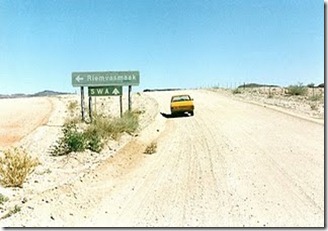
When we went on road trips during the school holidays, we were used to seeing long army convoys on the road – just another one of those facts of life which we endured because we knew these convoys were crucial to our survival. They were delivering logistic support and backup to the troops up North. They slowed down our progress on the long narrow roads of SWA, but they also gave us the assurance that someone was out there protecting us.

Convoy

I grew up seeing uniformed people everywhere I went, and thought this was quite normal. Windhoek was squirming with military personnel, and even my own dad worked for the army. The yearly Windhoek Agricultural Show was heavily sponsored and dominated by the army. We could see the newest weaponry, and the SWASPES special forces would do shows on the showgrounds where they performed mock attacks on terrorists.

We enjoyed watching the motorbikes do tricks, shooting at targets while flying through the air, and the dogs attacking make-believe terrorists who were hiding in the crowd. They would have smoke all over the grounds and “donderbuis” bombs going off – great stuff to watch from the stands! The baddies would shoot at our soldiers and they would shoot back, killing the enemy in droves.

Ahh, what a joyful time it was indeed. I often dreamt of killing a terrorist myself one day.

There were helicopters and sometimes even Mirage fighters flying overhead, all of them displaying the might and pride of the South African Defence Forces.

Although the war was waged far away in the North of our country, we were all very much aware of it, and accepted it as a normal part of life. We were South Africa’s 5th province – we had the same Orange, White and Blue flag, and we sang the same national anthem with the same pride.

clip_image003

By our final school year, which we called “Matric”, or Standard 10, the young men all had to make some serious decisions. We received another blue computer-printed notice in an envelope. All of us got one – no one was spared.

In this little blue note, you were informed that you were expected to turn up at Suiderhof Military Base on 11 January 1988. It wasn’t a nice Outlook meeting request or a friendly letter, it was more like a stern command. The only way out was if you applied to go to university after school, but this was just a way of delaying the inevitable.

I tried to convince my parents that it would be better for me if I went to Stellenbosch to start my engineering studies – I’ll deal with the army later. My parents did not agree, and made me “volunteer” to join the army after school. According to them this would be better for me in the long run, because I might get married at University and the army experience is even worse for married men. “Get it over with and enjoy the rest of your life”, is basically what they prescribed.

Long story short: this decision was made swiftly and without further discussion – I was going to the army and that was that.

Once the matter was settled, those of us who made the decision to fight for God and country were revving up each other. We were animatedly discussing how brave we were and how many terrs we were going to kill, taking Caspirs for spins in the white Wamboland sand, jumping from helicopters and throwing around hand grenades all over the place. The army would never be the same after this lot enlisted…

In those days we did not yet have the luxury of the internet where you could research stuff at the click of a mouse. All we had to go on were the stories of the legends, and the stories that were told by those who went before us.

That is, if they said anything at all. Men will always tell about the fun stuff, and the funny stuff, but you don’t often hear about the killing and the fear and the hurt of losing a comrade in battle. Or the feeling of betrayal once it’s all over and people call you a baby killer or an evil racist.

Other than that, we had the propaganda and the embedded fear that these animals will run over our border and destroy our country – enough to make you want to go and massacre the lot of them.

There were all sorts of stories, but none of them unleashed the fear that the word “Osona” unleashed. This was the name of the Military school at Okahandja, also known as 1 SWAMIL.

Osona was where all the Southwest-African kids went for military training, and it was known as a place where kids died and young men were born overnight. There were horrible rumours about a terrible sergeant major who marched a soldier till he literally dropped dead, and about a torturous event called “Vasbyt”. This was where big men cried and the big brown army machine showed no mercy. This was where we were all destined to go – an infantry training school like none other. A place where canon-fodder was prepared before unleashing it to the unsuspecting enemy.

1 SWA Military school, Okahandja. The base is still there today, albeit in a much worse state than it was ever imagined to be during our days.

clip_image005

One Monday morning during our last weeks in school, we were all called up to the stage during assembly. The whole school could have a look at us and see the men who were destined to die for their country. We felt really good – all the girls were checking out the brave young lads who were risking their very lives to protect them. We were the ones fighting against the evil forces of the communists and the antichrist. (Yep, those were the exact words.) You can still see the photo in the back of our yearbook of 1987 – all of us standing there, ready to take on those commie bastards.

It felt great. For a while, anyway.

I had a look around, to get an idea of who my buddies were. It was good to see I wasn’t going to be alone – some of these idiots would have to endure Osona and Vasbyt with me, and this just made everything so much easier.

We were ready – as ready as anyone could have been. But the future turned out way different than any of us had ever imagined back then. And it changed quite suddenly, too.

I’ll tell you more about this in Part 3…

clip_image007

Read Part 3

Monday, August 22, 2011

My Bush War Story (Part 1)

I have been planning to write this story for quite a while. I have actually already written it - in another language called “Afrikaans”. Translating this story was however quite difficult, as so many of the typical army phrases and events were very classic South African terms, and are hard to explain to “foreigners”, if I may call them that.

After numerous conversations with people who were not residents in Southern Africa during this time - answering many questions about the bush war - I decided that I needed to get this written down. The stories need to be told to those who were not part of this interesting part of African history.

soldiers in the bush

Like thousands of other young white men in South Africa and South West Africa (Namibia), I was enrolled in National Service after my last school year, at the age of 18.

National service was not done on a volunteer-basis. Once you had managed to scrape through high school, you had two options - go to university, and do your national service afterwards, or join the army now and get it over with. There was a third option, but it would earn you six years in jail and a lifelong reputation of being a traitor to your country.

We were born in a country where we had to live with the constant awareness of having an enemy. This enemy was a terrorist group known as SWAPO. They attacked from Angola and would plant landmines on farms and kill innocent civilians. We grew up knowing this basic fact - that there was an enemy, and it had to be resisted. This enemy hated all that we stood for - our white skins, our Christian faith, and our capitalist lifestyle.

image

This enemy was supported by the Russians and the Cubans, and even East Germans were added to the mixture. It was a battle for survival, right in the middle of the Cold War. Around these parts the “cold war” was a real war, with bombs going off, guns being fired, tanks rolling and planes swooping down on enemy positions.

Landmines planted by SWAPO insurgents took out innocent civilians travelling on remote farm roads, and terrorists would infiltrate farms and massacre white families and their farm workers in the most brutal and inhumane ways.

landmine victims

In school, we were taught to watch out for suspicious items, like boxes or crates. We were taught how to evacuate our schools during bomb threats. And we saw on the news how black civilians in South Africa killed each other in the middle of the street by a cruel method called “necklacing”. A necklace was a primitive torturing machine – a person was stuck inside a car tyre, doused in petrol, and plainly set alight for the whole street to see.

necklace murder

This was our world, and this was our fight – a fight against the communist barbarians who would do anything to break down and destroy our way of life.

My grandmother joined the commandoes and learnt how to fire a rifle – just in case she ever needed to. And I know she wouldn’t have flinched if she ever needed to kill someone – it was either them or us, and we all knew this.

The battle, however, was never fought in Windhoek (central Namibia) or in South Africa, even though we were ready to expect anything. The battles were fought in the Northern regions of Namibia, North of an imaginative line we called the Kaplyn (Cut line). This area was indigenous land, and here the enemy could mix with the locals and infiltrate the country.

clip_image002

This region was heavily militarised, and patrolled by the SA Defence force on a daily basis. Every now and then small “contact situations” broke out, where terrorists in small groups engaged in fire-fights with the army. Other times there were massive conventional battles, where tanks, artillery and air power were all part of the game. South African forces invaded Angola regularly in order to wipe out SWAPO bases in Angola.

Prior to this, events in Angola and Mozambique were an ominous sign to those of us living in SA and SWA. In 1975, the new left-wing government of Portugal “freed” their colonies, and basically abandoned their Portuguese citizens and left them to the mercy of murderous communists. Those who were still alive, fled across the border and had to start new lives in South West Africa. The only property they had, was whatever they could load onto their vehicles when they fled Angola.  And they were the lucky ones…

We had heard the horror stories that these people told, and we were certain not to abandon our land in the same way – where would we go, anyway?

My personal story starts at high school – yep, you heard me. You’ll have to wait for the next part of this story to hear more…

Saturday, August 20, 2011

Making Biltong Down Under

When you’re from Windhoek, you can only spend so much time without biltong.  I was practically raised on this stuff.  I can still remember the first time my granddad got a kudu and we carved it up into little pieces and hung it up in the little room in our backyard.  I was still very young, but I remember it fondly – like it was yesterday.  I can still taste that kudu when I think about it. 

After nearly three years in Perth, and having to buy beef biltong from local butchers at ridiculous prices, I have finally put aside enough time to build a decent biltong drying cage so that I can start making my own biltong.

At first I tried to use a cheap dehydrator, but I will not recommend this to anyone.  If you don’t have one that has variable temperature control, it will just cook your meat while it’s drying, and it will taste like bad army food.

IMG_0863

The better way to make biltong is the traditional way – air drying.  I built myself a nice little cage out of flyscreen, rope and wooden planks, using a staple gun to attach the flyscreen to the sides.  The top and bottom covers are removable, to make it easy to access and clean the cage:

IMG_0972

I also added some wheels to make it easier to drag this thing around the house:

IMG_0976

The meat is prepared by marinading it in vinegar and the basic biltong spices: coriander, pepper, salt and a little brown sugar.

IMG_0859

Then these spiced beauties are hung in the cage by attaching little hooks through them. S-shaped hooks made out of normal binding wire does the job perfectly.

IMG_1125

Using a fan to help blow-dry the meat makes the curing process a little faster, but is not essential.  It does help, however, if you have moving air around the meat.

IMG_1134

Look at these beauties – pure nature at it’s best: environmentally friendly, bio-degradable, and extremely good for my heart and emotional well-being:

IMG_1129

A good piece of biltong is what makes life worth living.

IMG_1140

(No additional animals were killed during the production of this blog…)

Monday, July 11, 2011

The Carbon Tax Fiasco

The Australian government is currently in the process of introducing a new carbon tax. The purpose of this tax supposedly is to bring down carbon emissions. 

They “explain” this in the following diagram:

image

But I don’t understand how it works. I am just a normal run-of-the-mill stupid taxpayer.

What they claim to be doing, is as follows:

Tax the 500 largest carbon-polluting companies in Australia, (like energy producers). Use half of that tax and refund it to the public in the form of a tax cut or a payment to make up for the increase in costs that will be passed on to the end-user.

Somehow, this will make these large companies reduce their emissions. It will also make the “greener” alternatives more attractive and competitive on a cost basis, and therefore we will all live happily ever after.

What they don’t say is that no one actually has to reduce their carbon output. To me, this looks like a way for the government to collect more tax revenue and pass it on to the tax-payer, creating a more socialist state. Depending on how you position yourself, this could be a good or a bad thing, but actually has nothing to do with pollution!

My point here is that even though things will cost more, the government is supposedly going to hand out rebates so that the average Australian can cope with these costs. Which means that the coal-powered power station can keep on polluting as it always has, and because they now pay more tax, they are justified in increasing their electricity prices, for which the good old government will refund the average household. How easy.

The basic reason for all of this is that so-called greener alternatives are much more expensive than burning coal. The government wants us to get used to paying much more for our electricity bills (and anything else for that matter) than we need to, and they’re forcing up the price of existing technologies just so that green alternatives can become synthetically competitive.

Imagine this scenario: the power generators actually start reducing their carbon pollution footprint. This means that they pay less carbon tax, which means our wise government does not have the tax revenue to pass on to consumers, even though the average consumer will now still be paying much more for almost everything they consume. The government will run into even more debt or will stop the rebates.

Not exactly a win-win situation if you ask me. The logic that is being applied here is based on way too many assumptions. Only politicians can come up with stupid ideas like these. Politicians who only worry about the next election and the current status quo.